
Showing posts with label Postmodern. Show all posts

Thursday, August 9, 2018

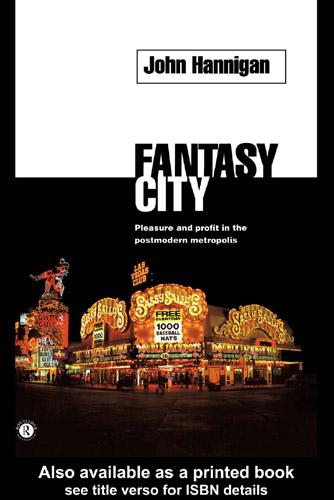
Fantasy City: Pleasure and Profit in the Postmodern Metropolis


Fantasy City: Pleasure and Profit in the Postmodern Metropolis
1998 | 256 pages | PDF | 5 MB

In a devastating critique of what he terms the postmodern American city, Hannigan, a sociology professor at the University of Toronto, charts a growing trend: the spreading infrastructure of megaplex cinemas, malls, themed restaurants, casinos, music megastores and other large-scale entertainment complexes.

 In his skeptical view, such spaces transform the public world into insular commercialized spheres, allowing leisure and conviviality without real social interaction. Hannigan questions the alleged economic benefits these sites hold for local communities, arguing that they threaten the destruction of neighborhoods and local identities while creating a polarized metropolis catering to the overwhelming middle-class desire for predictability and security.

 He casts a dour eye on the overlap of "eatertainment," "edutainment" and "shopertainment" and examines the alliance of players involved in building the postmodern leisure environment?real estate developers, corporate investors, retail operators and giant entertainment companies such as Disney, Universal, Sony, Warner Bros., Rank and Ogden. Looking back on the "golden age" of popular urban entertainment (1890-1925) when vaudeville halls, baseball stadiums, nightclubs and amusement parks blossomed, Hannigan argues that the captains of leisure maintained tight social control over a public culture that fostered the illusion of a democratic crowd where city dwellers mingled freely, regardless of race, class and gender. His provocative and far-sighted report will engage urban planners and all who care about the fate of U.S. cities. 


Wednesday, July 11, 2018

Complexity and Contradiction in Architecture


Complexity and Contradiction in Architecture
Robert Venturi
"The Museum of Modern Art, New York" | July 2, 2002 | 136 pages | PDF | 29 MB

First published in 1966, and since translated into 16 languages, this remarkable book has become an essential document in architectural literature. As Venturi's "gentle manifesto for a nonstraightforward architecture," Complexity and Contradiction in Architecture expresses in the most compelling and original terms the postmodern rebellion against the purism of modernism. Three hundred and fifty architectural


Sunday, June 24, 2018

Archigram : Architecture without Architecture


Archigram : Architecture without Architecture
2005 | 440 pages | PDF | 10,8 Mb

In the 1960s, the architects of Britain's Archigram group and Archigram magazine turned away from conventional architecture to propose cities that move and houses worn like suits of clothes. In drawings inspired by pop art and psychedelia, architecture floated away, tethered by wires, gantries, tubes, and trucks. 

In Archigram: Architecture without Architecture, Simon Sadler argues that Archigram's sense of fun takes its place beside the other cultural agitants of the 1960s, originating attitudes and techniques that became standard for architects rethinking social space and building technology. 

The Archigram style was assembled from the Apollo missions, constructivism, biology, manufacturing, electronics, and popular culture, inspiring an architectural movement—High Tech—and influencing the postmodern and deconstructivist trends of the late twentieth century.

Although most Archigram projects were at the limits of possibility and remained unbuilt, the six architects at the center of the movement, Warren Chalk, Peter Cook, Dennis Crompton, David Greene, Ron Herron, and Michael Webb, became a focal point for the architectural avant-garde, because they redefined the purpose of architecture. 

Countering the habitual building practice of setting walls and spaces in place, Archigram architects wanted to provide the equipment for amplified living, and they welcomed any cultural rearrangements that would ensue. 

Archigram: Architecture without Architecture—the first full-length critical and historical account of the Archigram phenomenon—traces Archigram from its rediscovery of early modernist verve through its courting of students, to its ascent to international notoriety for advocating the "disappearance of architecture."


Friday, April 8, 2011

Fantasy City: Pleasure and Profit in the Postmodern Metropolis


"Fantasy City: Pleasure and Profit in the Postmodern Metropolis"
John Hannigan,
Routledge | November 10, 1998 | ISBN: 0415150981 | 256 pages | PDF | 5 MB


In a devastating critique of what he terms the postmodern American city, Hannigan, a sociology professor at the University of Toronto, charts a growing trend: the spreading infrastructure of megaplex cinemas, malls, themed restaurants, casinos, music megastores and other large-scale entertainment complexes. In his skeptical view, such spaces transform the public world into insular commercialized spheres, allowing leisure and conviviality without real social interaction. Hannigan questions the alleged economic benefits these sites hold for local communities, arguing that they threaten the destruction of neighborhoods and local identities while creating a polarized metropolis catering to the overwhelming middle-class desire for predictability and security. He casts a dour eye on the overlap of "eatertainment," "edutainment" and "shopertainment" and examines the alliance of players involved in building the postmodern leisure environment?real estate developers, corporate investors, retail operators and giant entertainment companies such as Disney, Universal, Sony, Warner Bros., Rank and Ogden. Looking back on the "golden age" of popular urban entertainment (1890-1925) when vaudeville halls, baseball stadiums, nightclubs and amusement parks blossomed, Hannigan argues that the captains of leisure maintained tight social control over a public culture that fostered the illusion of a democratic crowd where city dwellers mingled freely, regardless of race, class and gender. His provocative and far-sighted report will engage urban planners and all who care about the fate of U.S. cities.

or