
Showing posts with label Energy. Show all posts

Sunday, June 17, 2018

House Rating Schemes : From Energy to Comfort Base


House Rating Schemes : From Energy to Comfort Base
 2010 | 300 pages | PDF | 2,6 MB

"House Rating Schemes" provides information to students, architects and researchers in the field of the built environment.

 It reviews current House Rating Schemes (HRS) used in different countries and investigates how these schemes assess the thermal performance of a house. It challenges the way that these schemes assess building energy efficiency and their inability to evaluate free running buildings which do not need an energy load for heating and cooling indoor environments. 

Finally, the book proposes a new index and method for HRS in which the efficiency of a house design can be evaluated with reference to its thermal performance in both free running and conditioned operation modes. 

The book deals with various approaches and methods for rating buildings on the basis of different indexes, with implications for both energy efficiency and thermal comfort. It also guides readers through a computer simulation program for developing a rating system that evaluates and ranks building energy efficiency.
 

Download : Oboom / Mega

Wednesday, March 14, 2018

Energy and Environment in Architecture


Energy and Environment in Architecture :
A Technical Design Guide  
PDF | 178 pages | 7,8 mb

Download : Oboom / mega

Tuesday, March 13, 2018

Architecture - Comfort and Energy


Architecture - Comfort and Energy
PDF | 241 pages | 15 MB

In this book we seek to approach the architecture-energy combination and its relationship to human comfort and the environment .

Download : Oboom

Saturday, August 20, 2016

Wednesday, October 16, 2013

Energy Conservation in Buildings : A Guide to Part L of the Building Regulations


Energy Conservation in Buildings : 
A Guide to Part L of the Building Regulations
J.R. Waters

The conservation of fuel and power in buildings is an important part of the UK government's strategy to reduce national energy conservation. The revision to Part L of the Building Regulations, which came into force on 1 April 2002, lays down detailed and extensive requirements for conserving energy in almost all buildings and it covers most potential causes of building energy consumption.

This guide explains these detailed requirements and shows how they apply to particular cases, with the use of numerous worked examples. It includes a chapter on air tightness and leakage testing, a topic with which many building professionals are unfamiliar.


Thursday, October 3, 2013

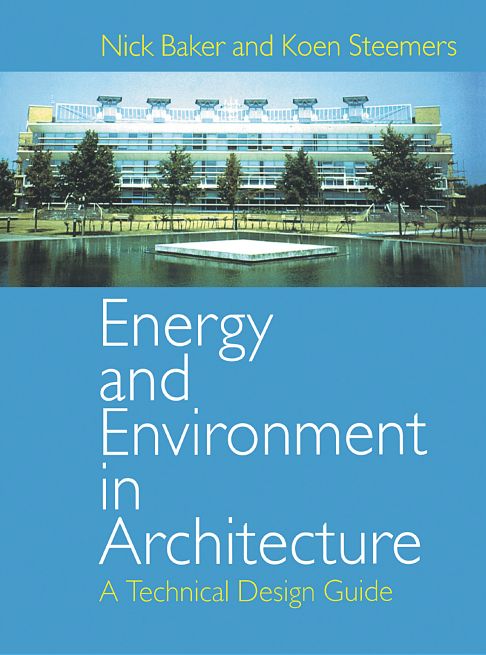
Energy and Environment in Architecture : A Technical Design Guide


Energy and Environment in Architecture : 
A Technical Design Guide.
Nick Baker, Koen Steemers

A unique and revolutionary text which explains the principles behind the LT Method (2.1), a manual design tool developed in Cambridge by the BRE. The LT Method is a unique way of estimating the combined energy usage of lighting, heating, cooling and ventilation systems, to enable the designer to make comparisons between options at an early, strategic stage.

In addition,Energy and Environment in Architecture the book deals with other environmental issues such as noise, thermal comfort and natural ventilation design. A variety of case studies provide a critique of real buildings and highlight good practice. These topics include thermal comfort, noise and natural ventilation.


Tuesday, July 16, 2013

Architecture - Comfort and Energy


Architecture - Comfort and Energy
C. Gallo, Marco Sala, A. A. M. Sayigh
Pergamon Press Inc., September | 1998 | PDF | 241 pages | 15 MB

 Hardbound. In this book we seek to approach the architecture-energy combination and its relationship to human comfort and the environment .There are chapters on thermal comfort, low energy architecture dealing with various criterion for comfort in different parts of the World.
The book also seeks to understand how previous generations lived in harsh climates and without abundant sources of energy, yet managed to design and build appropriate dwellings providing both comfort and harmony with the environment.

Other chapters deal with the bioclimatic concept in Vernacular Architecture; the major role which climate plays at different locations and how this can dictate the shape and form of the buildings and save energy; the importance of micro-climate and its various elements and usage; ventilation and its importance in buildings and the technology for modern architecture.


Sunday, July 14, 2013

The Engineering Guide to LEED-New Construction : Sustainable Construction for Engineers


"The Engineering Guide to LEED-New Construction : S
ustainable Construction for Engineers, Second Edition "
Liv Haselbach ,
2010 | 464 pages | PDF | 5,2 MB


An Up-to-Date Guide to the Latest LEED-New Construction Guidelines

Fully revised for version 3.0 of the LEED-New Construction rating system (LEED-2009), this GreenSource book helps you acquire the skills needed to apply LEED-NC to sustainable construction projects.

The Engineering Guide to LEED-New Construction, second edition, offers comprehensive coverage of the environmental systems and impacts on which many of the LEED-NC subcategories are based. Detailed equations and exercises in the book can be used to perform the calculations outlined in LEED-NC. Valuable information on real-world applications of LEED-NC in military, low-impact development (LID), and other sectors is included in this practical resource.

THE ENGINEERING GUIDE TO LEED-NEW CONSTRUCTION COVERS:

•Introduction to the U.S. Green Building Council's LEED-NC rating system
•Sustainable sites
•Water efficiency
•Energy and atmosphere
•Materials and resources
•Indoor environmental quality
•Innovation in design and regional priorities
•A systematic view of green and minimum program requirements
•Department of Defense sustainable construction and indoor air quality (IAQ)

Energy and Environment in Architecture: A Technical Design Guide


Energy and Environment in Architecture: A Technical Design Guide
Nick Baker, 
English | 2000 | PDF | 178 pages | 7,8 mb

A unique and revolutionary text which explains the principles behind the LT Method (2.1), a manual design tool developed in Cambridge by the BRE. The LT Method is a unique way of estimating the combined energy usage of lighting, heating, cooling and ventilation systems, to enable the designer to make comparisons between options at an early, strategic stage.
In addition,Energy and Environment in Architecture the book deals with other environmental issues such as noise, thermal comfort and natural ventilation design. A variety of case studies provide a critique of real buildings and highlight good practice. These topics include thermal comfort, noise and natural ventilation.


Sunday, June 2, 2013

House Rating Schemes : From Energy to Comfort Base


House Rating Schemes : From Energy to Comfort Base
Maria Kordjamshidi, 
2010 |  | 300 pages | PDF | 2,6 MB

"House Rating Schemes" provides information to students, architects and researchers in the field of the built environment. It reviews current House Rating Schemes (HRS) used in different countries and investigates how these schemes assess the thermal performance of a house. It challenges the way that these schemes assess building energy efficiency and their inability to evaluate free running buildings which do not need an energy load for heating and cooling indoor environments. Finally, the book proposes a new index and method for HRS in which the efficiency of a house design can be evaluated with reference to its thermal performance in both free running and conditioned operation modes. The book deals with various approaches and methods for rating buildings on the basis of different indexes, with implications for both energy efficiency and thermal comfort. It also guides readers through a computer simulation program for developing a rating system that evaluates and ranks building energy efficiency.

Thursday, January 31, 2013

House Rating Schemes : From Energy to Comfort Base


"House Rating Schemes : From Energy to Comfort Base"
Maria Kordjamshidi,
Springer | 2010 | 300 pages | PDF | 2,6 MB

"House Rating Schemes" provides information to students, architects and researchers in the field of the built environment. It reviews current House Rating Schemes (HRS) used in different countries and investigates how these schemes assess the thermal performance of a house. It challenges the way that these schemes assess building energy efficiency and their inability to evaluate free running buildings which do not need an energy load for heating and cooling indoor environments. Finally, the book proposes a new index and method for HRS in which the efficiency of a house design can be evaluated with reference to its thermal performance in both free running and conditioned operation modes. The book deals with various approaches and methods for rating buildings on the basis of different indexes, with implications for both energy efficiency and thermal comfort. It also guides readers through a computer simulation program for developing a rating system that evaluates and ranks building energy efficiency.


Friday, July 1, 2011

Advanced Lighting Controls: Energy Savings, Productivity, Technology And Applications


Advanced Lighting Controls: Energy Savings, Productivity, Technology And Applications
Publisher: Fairmont Pr | ISBN: 0881735108 | edition 2005 | PDF | 315 pages | 12,5 mb

Advanced Lighting Controls is edited by Craig DiLouie and written for engineers, architects, lighting designers, electrical contractors, distributors, and building owners and managers. Advanced lighting controls, indicated by research as the "next big thing," are now mandated by the ASHRAE/IES 91.1-1999 energy standard, the basis for all state energy codes in the U.S., and are becoming the norm rather than the exception in new construction. This book provides in-depth information about the major trends, technologies, codes, and design techniques shaping the use of today's lighting control systems, including dimming, automatic switching, and global as well as personal control.


Wednesday, March 2, 2011

Ventilation and Airflow in Buildings: Methods for Diagnosis and Evaluation


Ventilation and Airflow in Buildings: Methods for Diagnosis and Evaluation (Buildings, Energy and Solar Technology Series)
Earthscan Publications Ltd. | ISBN-10: 184407451X | 2008 | 128 pages | PDF | 2 MB

Energy efficiency in buildings requires, among other things, that ventilation be appropriately dimensioned: too much ventilation wastes energy, and insufficient ventilation leads to poor indoor air quality and low comfort. Studies have shown that ventilation systems seldom function according to their commissioned design. They have also shown that airflow measurement results are essential in improving a ventilation system.

This key handbook explains why ventilation in buildings should be measured and describes how to measure it, giving applied examples for each measurement method. The book will help building physicists and ventilation engineers to properly commission ventilation systems and appropriately diagnose ventilation problems throughout the life of a building. Drawing on over 20 years of experience and the results of recent international research projects, this is the definitive guide to diagnosing air flow patterns within buildings.

megaupload
or
rapidshare