
Showing posts with label Ancient Egypt. Show all posts

Tuesday, October 9, 2018

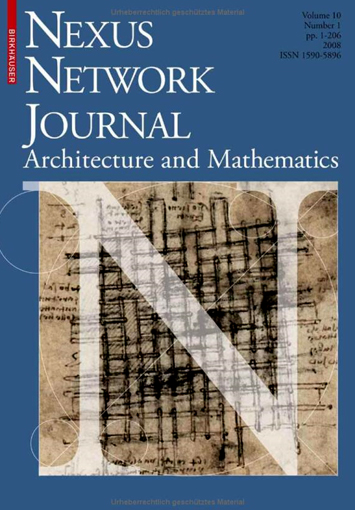
Nexus Network Journal 10,1 (Architecture and Mathematics)


Nexus Network Journal 10,1 (Architecture and Mathematics)
2008-05-23| PDF | 206 pages | 24 Mb

The quintessential Renaissance Man, Leonardo da Vinci was well aware of the fundamental importance of mathematics for architecture. This issue of the Nexus Network Journal examines Leonardo’s knowledge of theoretical mathematics, explores how he used concepts of geometry in his designs for architectural projects, and reports on a real-life construction project using Leonardo’s principles. 

Authors include Sylvie Duvernoy, Kim Williams, Rinus Roelofs, Biagio Di Carlo, Mark Reynolds, João Pedro Xavier, Vesna Petresin, Christopher Glass, and Jane Burry. To complete the issue Rachel Fletcher writes her Geometer’s Angle column on "Dynamic Symmetry", Michael Ostwald reviews A Theory of General Ethics by Warwick Fox, Sarah Clough Edwards reviews Inigo Jones and the Classical Tradition by Christy Anderson, and Sylvie Duvernoy reviews Architecture and Mathematics in Ancient Egypt by Corinna Rossi.


Friday, April 13, 2018

Egyptian Towns and Cities


Egyptian Towns and Cities
(Shire Egyptology)
 PDF | 72 pages | 3,2 Mb

This book surveys the main kinds of urban settlement and town planning that existed in ancient Egypt before the
town planning. The evolution and growth of Predynastic villages is traced as an essential prelude to the much greater achievements of the Pharaohs in establishing first towns and then cities. The later growths are shown to be of two basic types, royal foundations and those which underwent a natural expansion throughout history. From this they are classified as constituting various standard types based on function: provincial centres, planned workmen's villages, military and frontier towns, towns inhabited by funerary priests and, ultimately, royal residences and the capitals. The range of size and material is tremendous, covering small closely knit communities of a few hundred people, towns with several thousand inhabitants and vast cities, as large as any in the ancient world, with tens of thousands of citizens.
 
Download : Oboom / Mega

Friday, October 28, 2016

Wednesday, July 10, 2013

Egyptian Towns and Cities (Shire Egyptology)


Egyptian Towns and Cities (Shire Egyptology)
Eric P. Uphill,
Shire | 2008-03-04 | PDF | 72 pages | 3,2 Mb

This book surveys the main kinds of urban settlement and town planning that existed in ancient Egypt before the Hellenistic period. The evolution and growth of Predynastic villages is traced as an essential prelude to the much greater achievements of the Pharaohs in establishing first towns and then cities. The later growths are shown to be of two basic types, royal foundations and those which underwent a natural expansion throughout history. From this they are classified as constituting various standard types based on function: provincial centres, planned workmen's villages, military and frontier towns, towns inhabited by funerary priests and, ultimately, royal residences and the capitals. The range of size and material is tremendous, covering small closely knit communities of a few hundred people, towns with several thousand inhabitants and vast cities, as large as any in the ancient world, with tens of thousands of citizens.

Saturday, May 14, 2011

Nexus Network Journal 10,1 (Architecture and Mathematics)


"Nexus Network Journal 10,1 (Architecture and Mathematics)"
Kim Williams,
Birkhäuser Basel | ASIN: 3764387270 | 2008-05-23| PDF | 206 pages | 24 Mb


The quintessential Renaissance Man, Leonardo da Vinci was well aware of the fundamental importance of mathematics for architecture. This issue of the Nexus Network Journal examines Leonardo’s knowledge of theoretical mathematics, explores how he used concepts of geometry in his designs for architectural projects, and reports on a real-life construction project using Leonardo’s principles. Authors include Sylvie Duvernoy, Kim Williams, Rinus Roelofs, Biagio Di Carlo, Mark Reynolds, João Pedro Xavier, Vesna Petresin, Christopher Glass, and Jane Burry. To complete the issue Rachel Fletcher writes her Geometer’s Angle column on "Dynamic Symmetry", Michael Ostwald reviews A Theory of General Ethics by Warwick Fox, Sarah Clough Edwards reviews Inigo Jones and the Classical Tradition by Christy Anderson, and Sylvie Duvernoy reviews Architecture and Mathematics in Ancient Egypt by Corinna Rossi.